
Wrongful termination victims who hired a wrongful termination attorney received average settlements of $48,800, compared to $19,200 victims who did not have a lawyer according to national data. While that might sound straightforward, the average wrongful termination settlement can vary widely based on many different factors.
Taking a look at California specifically, we see a much higher average settlement amounts. According to a California Civil Rights Department Report the state secured $116.5 million through 788 settlements for all types of civil rights violations including employment discrimination. If you break that down into individual settlements, that is an average of $147,843 per settlement. These claims covered employment cases, and other civil rights violations, which also include wrongful termination claims.
Let's take a look at some of the numbers:
- Data from a national survey found settlements averaged $48,800 with a lawyer versus $19,200 without (nationwide data, likely higher now due to inflation)
- Having an attorney more than doubled the chances of getting paid: 64% with lawyers received compensation versus 30% without
- California's settlements averaged $147,843 in 2023 across all civil rights cases, significantly higher than the federal average
- Lost wages drive most settlement values, but emotional distress and punitive damages add up fast
- California employment discrimination cases aren't subject to federal damage caps of $50,000-$300,000, which is why our settlements run higher
- Strong evidence like emails and witness statements can significantly increase your payout
When looking at these averages, remember that your case could be worth more or less and won't match the averages exactly. The wrongful termination settlement you receive will depend on factors such as:
- Your salary
- What your employer did
- The evidence you have
With that said, lets get into the details and bread down the math behind wrongful termination settlements.
California Wrongful Termination Calculator - Get A Settlement Estimate
Although an accurate wrongful termination calculator does not exist, you can get an idea of the potential compensation by evaluating your damages and examining similar past cases. To better understand the potential value of your claim, your best option is to speak with an attorney that specializes in wrongful termination claims. Kingsley Szamet provides complimentary initial consultations to help those affected by wrongful termination.
Table of Contents:
- What Data Actually Shows About California Settlement Amounts
- My Experience: What I See in Wrongful Termination Settlements
- Federal Damage Caps Don't Apply to California State Claims
- Typical Settlement Ranges by Case Severity
- How to Estimate Your Case Value
- What Makes a Termination Wrongful Under California Law
- Types of Wrongful Termination Claims
- Is a Wrongful Termination Lawsuit Worth It?
- How We Calculate Damages
- Factors That Increase Your Payout
- Frequently Asked Questions
- Getting Legal Help for Your Case
What Data Actually Shows About California Settlement Amounts
How much is a wrongful termination lawsuit worth in California? As we went over earlier, that can depend on a number of different factors, but one thing we do know is the average settlement amount from a few different sources. Pay close attention to these next few sections. This is where I am going to show you the actual numbers from government reports and verified surveys. When you better understand the data that does and does not exist you can set more realistic expectations.
California Civil Rights Data (2023)
The California Civil Rights Department's 2023 Annual Report shows they collected $116.5 million through 788 settlements. As stated before, that is an average settlement of $147,843 per person.
Here's what you need to know about this number: it covers all types of civil rights violations the CRD handles. The CRD doesn't publish separate averages for wrongful termination cases specifically.
Federal Employment Discrimination Data (FY 2024)
Now let's dig into the Federal averages and compare those to California specific numbers. We will start by looking at the EEOC's 2024 Annual Performance Report, which shows they recovered almost $700 million for about 21,000 workers. Here's the breakdown:
- Private sector cases: In the private sector there was $469.6 million secured for 13,516 people through mediation, conciliation, and pre-litigation settlements. If we do the math ($469,600,000 ÷ 13,516) that is an average settlement of $34,742 per person. This includes all types of employment discrimination, not just wrongful termination specifically. The EEOC doesn't break down settlements by specific claim type.
- Federal employee cases: Federal claims resulted in $190 million recovered for 3,041 federal workers. That comes out to an average settlement of $62,480 per person.
- Court cases: Claims that went to court secured $40 million for 4,304 people through litigation. When we do the math, that works out to be an average settlement of $9,294 per person. This number looks lower because many litigation settlements are class actions where one settlement covers hundreds of workers who each get smaller individual amounts.
Most of the money came through mediation and settlement, not trial. The EEOC reported that 71.2% of mediations succeeded in FY 2024, recovering $243.2 million.
What Employees Actually Received
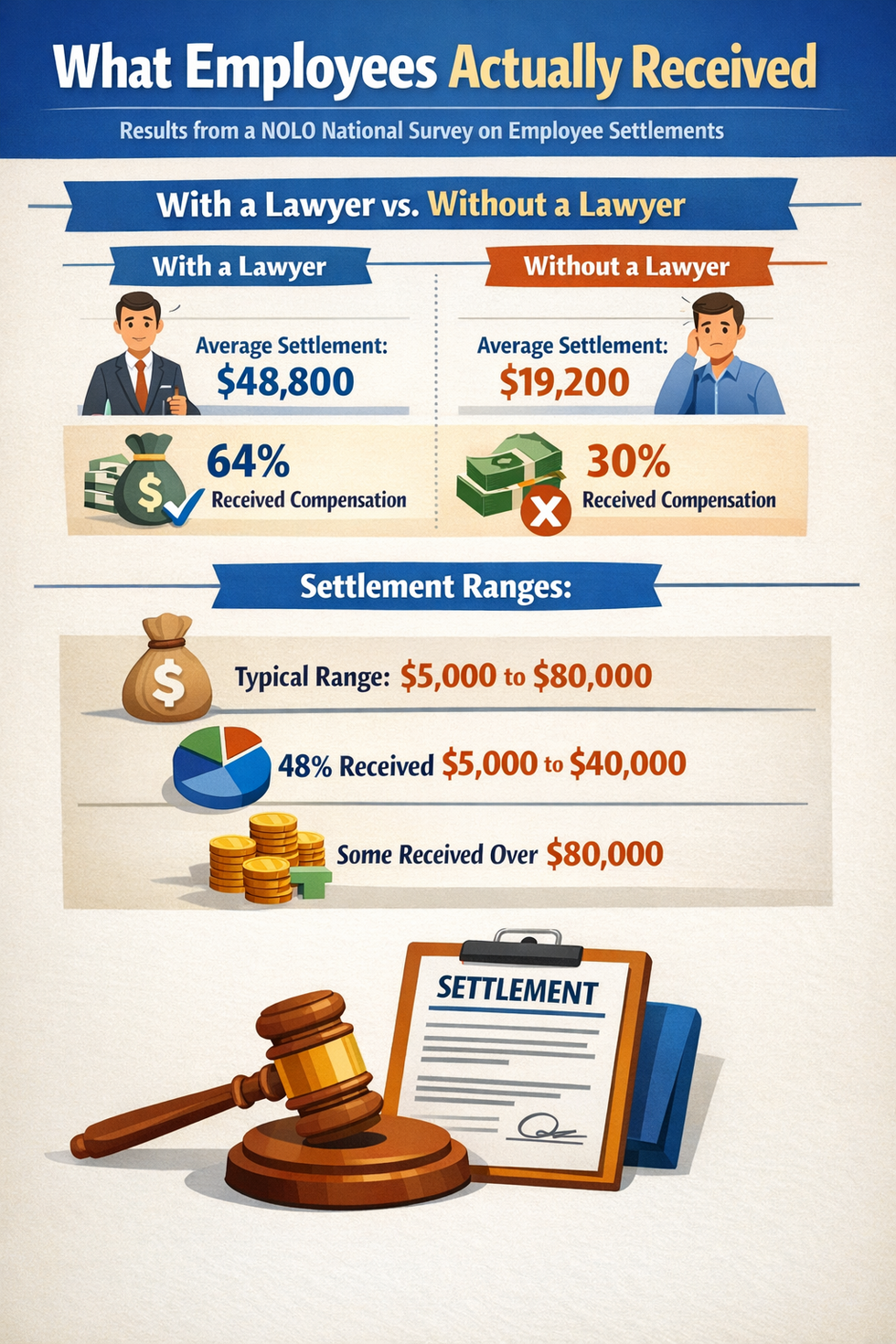
The most detailed publicly available data on what individual employees actually received in settlements comes from a national survey done by NOLO. Here's what they found:
With a lawyer versus without:
- Average with attorney: $48,800
- Average without attorney: $19,200
- Success rate with attorney: 64% received compensation
- Success rate without attorney: 30% received compensation
Settlement ranges:
- Typical range: $5,000 to $80,000
- Nearly half (48%) received: $5,000 to $40,000
- Some received much more than $80,000
Other factors that affected settlement amounts:
- Negotiating versus accepting the first offer: Those who negotiated received $41,500 on average compared to $19,200 for those who accepted the first offer.
- Filing a lawsuit: Readers who filed lawsuits were nearly twice as likely to receive a settlement (70% versus 36%) and received nearly $12,000 more on average than those who didn't file.
- Employer size: Large employers with over 100 employees paid an average of $43,400, almost twice what smaller employers paid.
California's higher average likely reflects several factors: no federal damage caps on state law claims, stronger employee protections under FEHA, and the fact that California cases can include unlimited punitive damages when employers act with malice or fraud. In some cases, you may also be entitled to front pay, which compensates you for future lost wages if reinstatement of employment after termination is not possible.
My Experience: What I See in Wrongful Termination Settlements
I've handled over 150 employment cases in California over nearly 30 years. When looking at this data I see one glaring difference: California cases will likely have a higher average wrongful termination settlement because there's no ceiling on damages when using state law claims under FEHA.
When I'm negotiating with another attorney, they know that punitive damages are on the table if their client acted with malice or fraud. That means no cap. This changes the entire conversation. In states that is limited by federal law, an employer is able to calculate their maximum exposure. In California, they can't. That uncertainty can increase settlement values.
Federal Damage Caps Don't Apply to California State Claims
This is a critical point to understand. These caps will only apply to federal claims under Title VII, ADA, and other federal statutes. When you bring a claim under California's Fair Employment and Housing Act (FEHA), these caps don't apply. You can recover unlimited compensatory and punitive damages if you prove your case.
Typical Settlement Ranges by Case Severity
| Case Damages | Average Settlement Received |
|---|---|
| Low | Between $5,000 and $30,000 |
| Moderate | Between $30,000 and $100,000 |
| High | Between $100,000 and $1,000,000+ |
Weaker cases usually involve limited evidence, short employment periods, or low wage loss. Moderate cases have decent evidence and measurable damages. Strong cases involve clear discrimination, substantial lost wages, or particularly bad employer conduct.
Settlement amounts vary wildly. A simple pay dispute might settle for $15,000. A discrimination case with good evidence can hit six figures. Your specific case depends on your facts.
How to Estimate Your Case Value
You can't plug numbers into a wrongful termination settlement calculator and get an accurate settlement prediction. Settlement values depend on too many variables that are specific to your situation.
But you can estimate a range by looking at:
- Your actual wage loss (back pay and front pay)
- The strength of your evidence
- The egregiousness of your employer's conduct
- Whether you can prove emotional distress with medical records
- The employer's size and financial resources
The best way to know what your case is worth? Talk to an experienced Los Angeles employment lawyer who handles wrongful termination cases regularly.
I offer free consultations at Kingsley Szamet Employment Lawyers to review your situation and give you a realistic assessment of your claim. After nearly 30 years and over 150 employment cases, I can usually tell you within the first conversation whether you have a case worth pursuing and what you might expect.
What Makes a Termination Wrongful Under California Law
Getting fired in California doesn't automatically mean you have a case. The law divides terminations into legal and illegal categories. Wrongful termination means your employer fired you for a reason the law prohibits.
California law makes it illegal to fire someone because of:
- Race
- Gender or sex
- Age (if 40 or older)
- Religion
- National origin or citizenship
- Disability
- Pregnancy or related medical conditions
- Sexual orientation or gender identity
- Medical condition
- Genetic information
- Marital status
- Military or veteran status
Retaliation also counts as wrongful termination. If you reported harassment, filed for workers' comp, complained about illegal behavior, or took protected leave (like FMLA or pregnancy disability leave), and then got fired, that's likely retaliation. Other examples of wrongful termination include firing an employee for refusing to engage in illegal activities or for taking protected leave, such as family or medical leave.
Types of Wrongful Termination Claims
California protects workers from termination for many illegal reasons. Knowing which category fits your situation helps determine which laws apply and what damages you can get.
FEHA Discrimination Claims
The Fair Employment and Housing Act bans firing people based on protected characteristics. FEHA covers employers with five or more workers and gives broader protection than federal law.
Before you can sue in court for a FEHA violation, you need to file a complaint with the California Civil Rights Department within three years of the discrimination. The CRD will investigate or give you a Right to Sue notice that allows you to file in court.
Retaliation Claims
Retaliation happens when your employer fires you for doing something the law protects. Common examples include reporting safety violations, filing a workers' comp claim, complaining about harassment, or blowing the whistle on illegal activity.
California Labor Code Section 1102.5 specifically protects whistleblowers who report law violations to government agencies. The CRD's 2023 data shows 1,832 employment complaints alleging "reported or resisted any form of discrimination or harassment," making retaliation one of the most common claim types.
Public Policy Violations
California recognizes wrongful termination when firing someone violates fundamental public policy, even without a specific statute. Examples include firing someone for refusing to break the law, taking jury duty (protected by Labor Code Section 230), or using family leave rights.
Is a Wrongful Termination Lawsuit Worth It?
If you have been wrongfully let go from your job, you owe to yourself to get the full amount of compensation that is due to you. Learning how to file a wrongful termination claim can feel like a complex process. A knowledge attorney can take some of the burden and help you get a maximum settlement. In fact, an attorney can more than doubled the chances of receiving any compensation and more than double the average settlement amount. Most Los Angeles wrongful termination lawyers work on contingency, meaning they only get paid if you win.
How We Calculate Damages
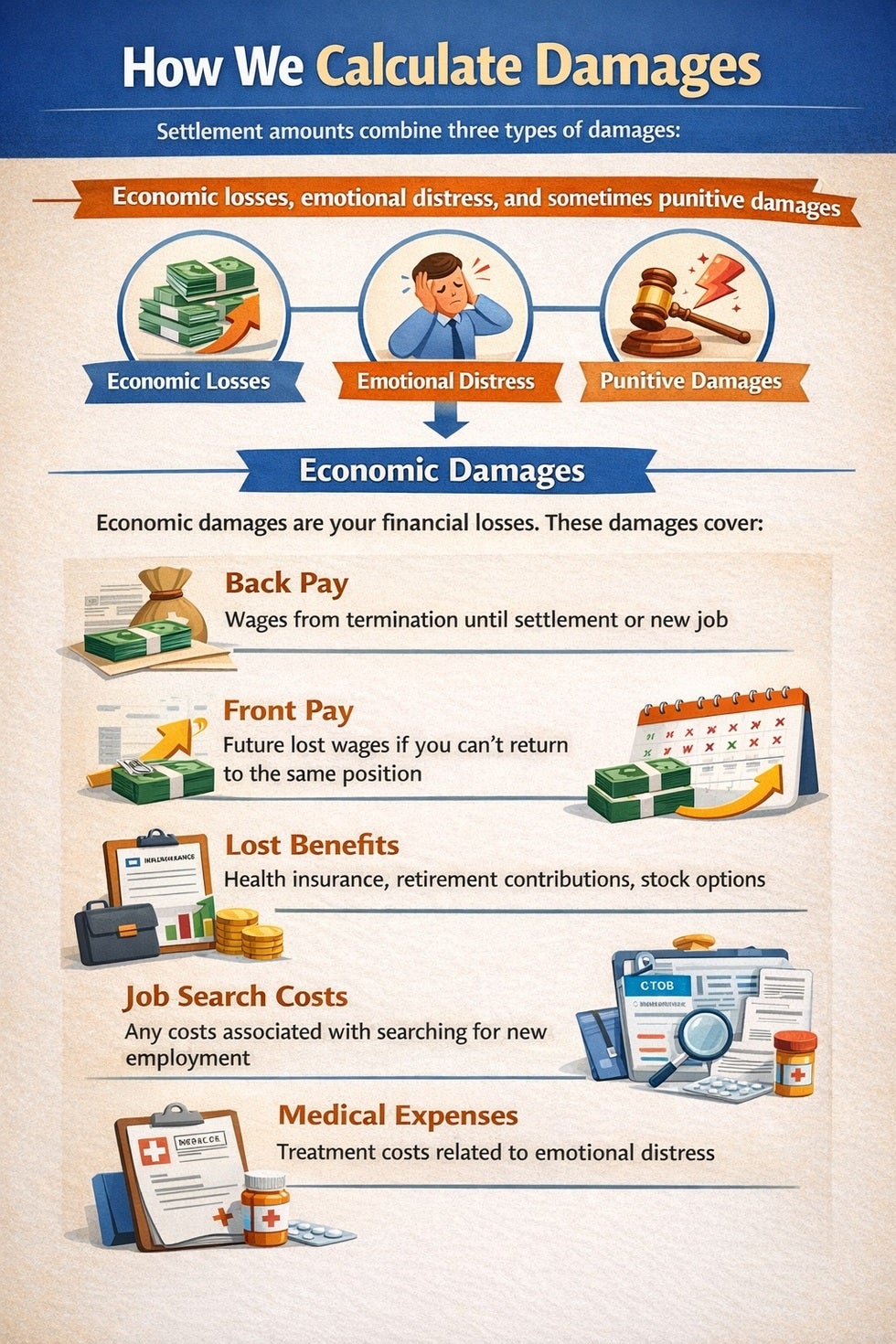
Settlement amounts combine three types of damages: economic losses, emotional distress, and sometimes punitive damages.
Economic damages are your financial losses. These damages cover:
- Back pay: Wages from termination until settlement or new job
- Front pay: Future lost wages if you can't return to the same position
- Lost benefits: Health insurance, retirement contributions, stock options
- Job search costs: Per data from a national survey, readers who claimed job search costs received $60,700 on average, almost three times higher than those who didn't ($20,600)
- Medical expenses: Treatment costs related to emotional distress
Example calculation:
If you earned $6,000 per month and were unemployed for 8 months, your gross back pay is $48,000. If you found a new job after 5 months earning $4,500 per month, subtract $13,500 (3 months × $4,500), leaving net back pay of $34,500.
Emotional Distress Damages
California allows you to recover for non-economic harm:
- Pain and suffering
- Anxiety and depression
- Humiliation and embarrassment
- Damage to professional reputation
- Loss of enjoyment of life
These damages are harder to quantify. Juries and employers take emotional distress more seriously when you have:
- Medical records from a therapist or psychiatrist
- Prescription records for anxiety or depression medication
- Testimony from family or friends about personality changes
- Documentation of how the termination affected your daily life
Punitive Damages
Punitive damages punish employers for particularly bad conduct. Under California Civil Code Section 3294, you need to prove malice, oppression, or fraud.
Punitive damages are rare and unpredictable, but they can be massive when awarded. They're most likely when:
- The employer knew the conduct was illegal and did it anyway
- Management participated directly in the discrimination
- The employer tried to cover up the illegal conduct
- The discrimination was part of a company-wide pattern
The California CRD's $100 million settlement against Riot Games included punitive elements because of the severity and pervasiveness of the gender discrimination.
Factors That Increase Your Payout
Beyond the type of claim, specific factors can push your settlement higher. Direct evidence like emails stating discriminatory reasons gets you higher settlements than circumstantial evidence.
Look for:
- Emails or texts with discriminatory language
- Recorded statements showing illegal intent
- Admissions by supervisors or HR
- Documents showing different treatment of similar employees
Timing and Sequence Matter
A clear timeline of retaliation dramatically strengthens your case. File an HR complaint on Monday, get fired Friday? That's powerful evidence. Report safety violations and get terminated two weeks later? Same thing.
The closer the timing between your protected activity and the termination, the stronger the inference of retaliation.
Your Income Level Drives Damages
Higher wage earners receive higher settlements. This makes sense because damages are calculated based on lost wages.
A $200,000 per year executive who loses their job has much higher back pay and front pay than a $50,000 per year worker. High earners also face longer unemployment periods when seeking comparable positions, which increases total damages.
Pattern Evidence Shows Intent
Multiple incidents showing consistent discrimination over time strengthen your case. One racist comment might be dismissed as a bad joke. Ten racist comments over six months show a pattern. Documentation matters.
Frequently Asked Questions
Is it worth suing for wrongful termination?
Suing for wrongful termination is worth considering if you have strong evidence and significant damages. The best way to learn if you have a strong case is to speak with an attorney.
How long does it take to settle a wrongful termination case?
A wrongful termination case could settle in as little as 6 to 18 months, though complex cases involving can take two to three years or more.
Do I need to file with the California Civil Rights Department before suing?
Yes, for FEHA discrimination claims, you must file an administrative complaint with the California Civil Rights Department within three years of the discriminatory act. You cannot file a lawsuit in court until you receive a Right-to-Sue notice from the CRD, which typically issues after the agency investigates or after you request an immediate Right-to-Sue letter.
Getting Legal Help for Your Case
If you've been wrongfully terminated, don't try to handle this alone. Having an attorney makes a massive difference. Contact Kingsley Szamet Employment Lawyers for a free case evaluation. We will review your situation honestly and tell you whether you have a case worth. We work on contingency, meaning you don't pay unless we win. Let us help you win your wrongful termination case!
With more than $300 million recovered for California workers and 30 years of experience, we can confidently help you get fair compensation for your California wrongful termination claim. Fill out our form or call us at (818) 990-8300 to get started.


Comments
There are no comments for this post. Be the first and Add your Comment below.
Leave a Comment